2026 is the year of athletic solidarity
Meet me at the turnstiles
Last week, the Professional Hockey Players Association formalized a new collective bargaining agreement (CBA) with hockey’s minor leagues. A two-day strike had brought negotiations to a head.
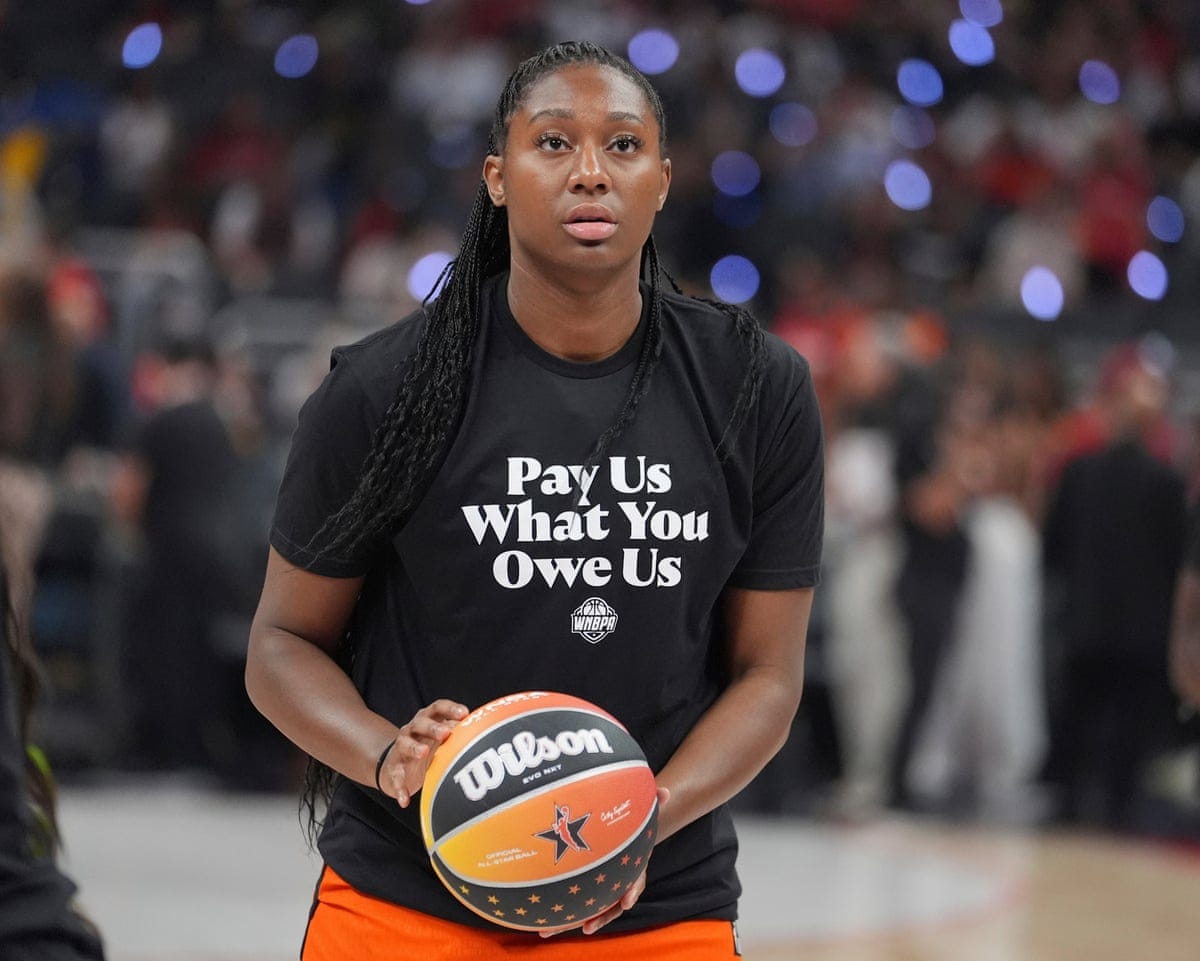
The WNBA and its players union have been negotiating a new CBA for months. The two sides are at a bitter impasse, with league business now frozen as talks continue.
The players union for the United Soccer League recently appealed to the public as talks for a new CBA in soccer’s second division drag on.
The union for the National Women’s Soccer League has recently pushed back against the league, which is trying to figure out how to keep top players like Trinity Rodman while maintaining strict salary caps. The union filed a grievance this week.
Major League Baseball’s CBA expires after this season, and the league and players are jostling for position in what may be a cataclysmic fight over a salary cap—Bryce Harper nearly stuffed MLB commission Rob Manfred into a locker when Manfred visited the Phillies’ clubhouse last season and broached labor issues.
And ICE agents are summarily executing law-abiding citizens.
Sorry—that last one slipped. (But hold that thought.)
There’s something coincidental about these labor fights flaring up at the same time. CBAs in professional sports often cover several years, and those cycles rarely align. It’s even rarer for them to be “opened up” or for there to be major labor skirmishes mid-cycle.
But there’s also something circumstantial about it. The affordability/cost of living crisis that is afflicting the masses is the same one affecting professional athletes, though I think it’s better characterized as an inequality crisis. Many, many solutions have been proposed to address the political issue of the day—what line do I stand in to receive a 50-year mortgage?—but change is not granted. It is forced, and professional athletes exemplify that this year.
In a brilliant piece for the New York Times, economics professor David Berri quantified the pay disparities in women’s pro basketball.
NBA salaries understandably swamp those in the WNBA in absolute terms. The men’s league brings in 50 times more revenue. But WNBA pay pales in relative terms, too, as the tables below show. The league minimum salary last season was $66,000, or about the cost of a dinner out in New York City anymore. Not that Joe Tsai would notice. The billionaire owns the Liberty, which, playing in Brooklyn, is worth $450 million, or 3,000% more than what he paid for the team just six years ago. WNBA’s minimum wage has increased 16% in the same time. That’s less than the rate of inflation.
As for soccer, the USL players union asserts that 25% of the workforce doesn’t gross $35,000 annually. The same percentage wasn’t offered a health insurance option by their employer, which is legal, apparently. The minimum salary in the NWSL last season was $48,500. In California, where I covered the San Diego Wave, a minimally-paid Wave player would have earned just 29% more than a full-time worker earning the state’s hourly minimum wage. If there is an exception to this group, then it is baseball.
The Major League Baseball Players Association is arguably the most effective and powerful union in the U.S. Rookies today earn close to $800,000 per year, while Shohei Ohtani signed a $700 million contract. It was a deal made possible by the union’s decades-long solidarity against a salary cap. MLB stands alone among American professional sports in lacking one. There is theoretically no limit to what an MLB player can be paid, meaning a baseball player can capture in wages more of the value that their labor creates than other athletes can.
But this is an exception in scale, not in form. All professional athletes are wage laborers, like you and I. Most professional athletes earn wages that keep them housed and fed, but not much more. Take the pay of minor baseball players, compiled by Baseball America in the table below. The players had to fight for every penny.
It’s true that the best players in the majors earn tens of millions of dollars annually, but statistically they’re a tiny minority and it doesn’t change the fact that they too are wage laborers. Starting pitcher Max Scherzer has earned $345 million in his career. He’s also a longtime leader at the MLBPA, having served on the union’s executive board for the last CBA negotiation in 2022. “Rather than complaining about [past CBAs], I’d just rather be on the front lines,” he told The Athletic then. “I had been involved with the union (before) but after seeing what was happening in 2016, players were making the wrong … they didn’t put enough emphasis on certain topics within the CBA. If I’m going to complain about something, I might as well show up and do it.”
He claimed after the 2022 CBA was struck that he’d never again involve himself in labor negotiations, but four years later he’s still an active player and the owners are still hellbent on a salary cap. You can’t put it past the biggest psychopath in baseball to rise to the occasion once more.
I have contended in these pages that what is good for the players is good for the fans. That’s reason enough to support their cause, but as neoliberalism and Trumpism are tightening their intertwined grip on the country it is worth looking to the players, in baseball and otherwise, whose outspoken unionism serves as a model.
I do not think it is a coincidence that the professional sports industry in America has been on a seven-decade heater and that a pro team is one of the hottest commodities in today’s economy. Rich men wait their turn to get their hands on one, especially in the four major leagues. Nothing turns on a billionaire more than a monopoly. Of course, those billionaires treat the labor like gnats, swatted at with derision. The owners don’t realize that elite pro sports are fun and dynamic and lucrative not despite well-compensated players, but because of them. Investment in the workforce is investment in the business. This was not inevitable. It was (and is) because of well-organized and active unions.
The MLBPA’s fight for free agency in the 1960s and ‘70s was almost indistinguishable from its fight for social and racial justice. Last year, the union for NWSL player was able to abolish the draft, one of the most anti-labor tools that sports leagues employ. A list of player union accomplishments between those years would be endless. But what’s more difficult to see and appreciate is what the player unions prevent. The grievance process, which adjudicates alleged violations of CBAs and worker rights, is most visible, but the mere presence of a union is important.
When leagues and team owners want to unilaterally make decisions affecting the players, they must first ask themselves whether a potential squabble with the union is worth it—worth it financially, legally, and PR-wise. The military calls this deterrence. Others call it accountability, and accountability is essential to the social order within a democracy. In fact, it might be the whole game, no pun intended.
Conversely, union membership rates in the general population have been declining for decades and have recently reached record lows, while income inequality has risen for decades. The economy is larger than ever. America is richer than ever. But everything just feels worse, if it’s not actually worse. That’s in part because we in the general population don’t have an organizing vehicle to wield collective action.
I am certain that the Trump administration is operating without a governing coalition. In other words, a majority of the voting public is against its myriad domestic, international, and economic policies. But those sentiments are not being harnessed collectively as an oppositional force. There is no threat of accountability for the Trump administration. Wittingly or not, MAGA exploits the lack of solidarity on the left.
This is not to say we all must join unions. I don’t know the first thing about starting one. This is also not to imply that unions are the only means for collective action. They are not. But I know a lot about power, which is either money or people. In sports, unions have the latter, owners the former, and the players have done more—have done more fighting—for workers in the past 70 years than the Democratic Party or the nonprofit industrial complex or all the good-intentioned marches.
So this is actually to say: In 2026, we should return to our childhood selves. We should want to be our heroes, the ones on the fields and pitches and courts. At some point, we stopped believing we could be like them, but that’s incorrect.


