


This is Out in Left, a newsletter by me, Brendan Dentino, about the intersection of sports and politics.
If you like what you read, please the button below to join the mailing list for FREE. And if you’ve been reading for a while, please considering becoming a paid subscriber to unlock all the articles and allow me to expand Out in Left’s offerings. And please share it with one person you know.
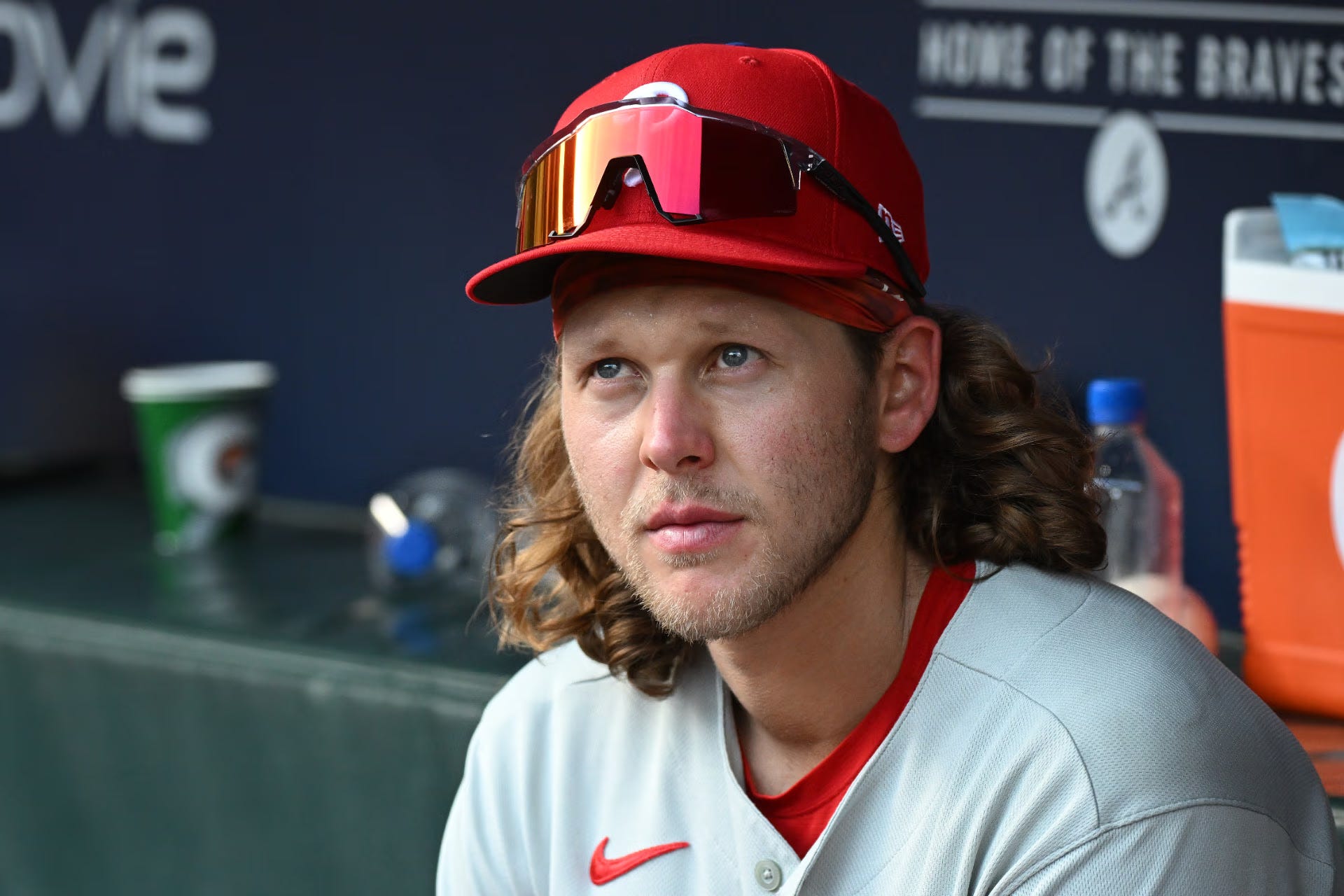
Someone recently told me I don’t seem like an angry person. They don’t know my feelings towards Alec Bohm. Never have I cheered for a more maddening player, and never for so long. Bohm played third base for my Philadelphia Phillies for seven long years. That’s because of MLB’s existing salary cap. The team was worse for it and so us fans suffered for it.
This salary cap is referred to as “team control,” and it was ushered in with the advent of arbitration. With an overwhelming, seemingly innocuous vote by the owners in 1975, the system was created. Both sides considered it a fair concession.
For a time they were right. Individual players stopped holding out for raises, the players writ large gained some agency over their careers, and the few cases that went to arbitration resulted in marginal financial costs to the teams. Today, after subsequent decades of collective bargaining, the arbitration system is a more complex and grotesque monster than Frankenstein, but the contours are simple.
Players earn league-minimum salaries for the first three years of their careers, and salaries for the subsequent three years are negotiated between the player and team or, failing that, determined by an arbiter. (Players reach Valhalla—free agency—after that sixth year.) For several reasons, Bohm lays bare the advantages of this salary cap system for the owners and the disadvantages for the players and fans. Below is a year-by-year analysis of these reasons, of my traumas.
Year 0: 2020
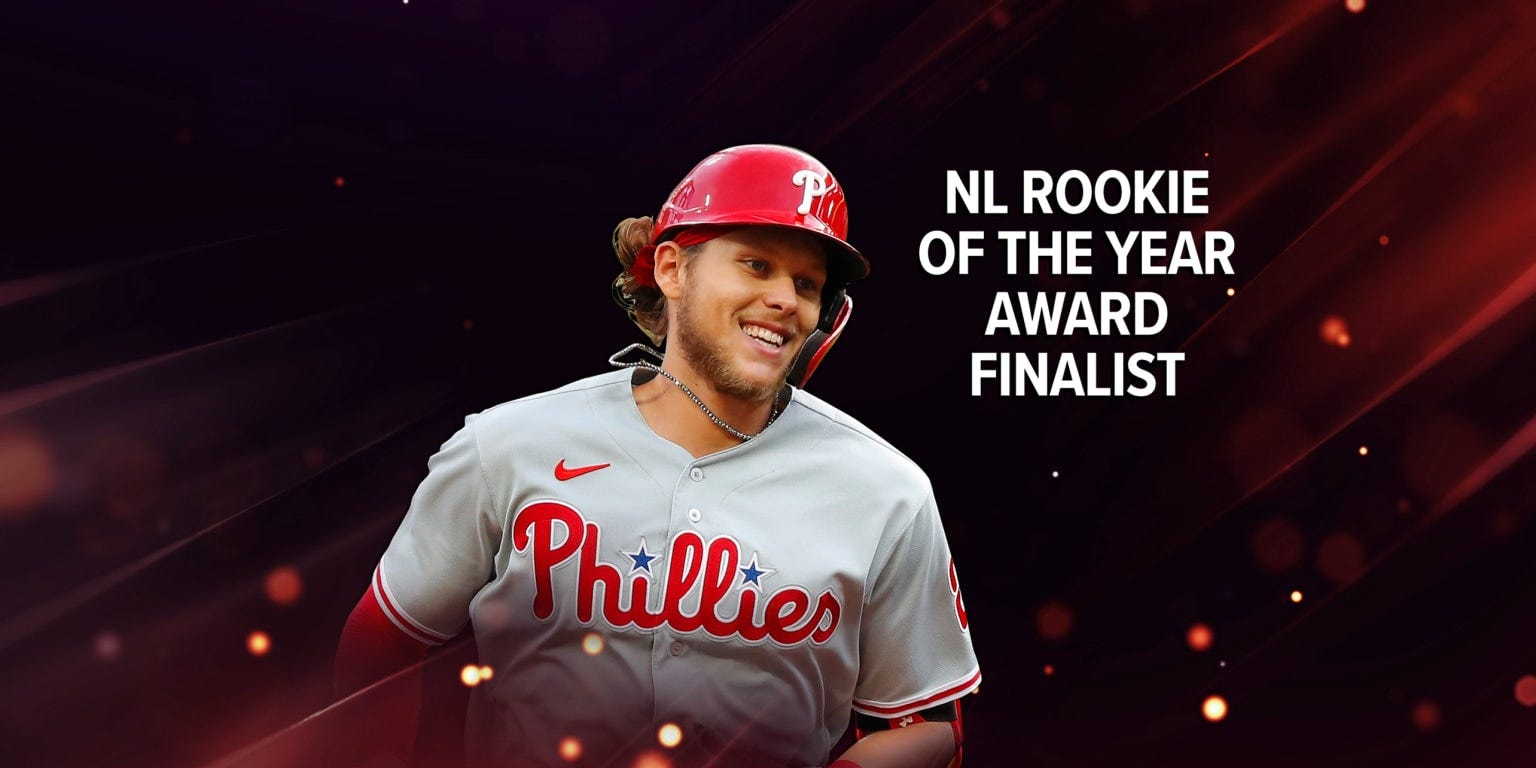
A 23-year-old Bohm debuted with the Phillies in the Covid-shortened season, and over the 60-game campaign he earned a prorated league-minimum salary of $563,500. He far outplayed those earnings. In just 44 games, Bohm accrued 1.3 fWAR. That rates to 4.8 fWAR over 162 games, making him a rare talent. According to FanGraphs, that production would have projected to cost about $12 million in the free agency market.
It’s too bad for Bohm that he came into the league when he did. Young players in 2020 did not earn a full year of service time—their countdown to free agency didn’t start ticking—which was a major concession to the owners in negotiations with the union over how to start the season amid the pandemic. This effectively granted the Phillies seven years of team control over Bohm, but it turned into the equivalent of a gifted Crock-Pot. It was useful for a single time, then it became annoying to have to store.
But that one time was glorious. Imagine: In your first year at a company you garner for or save your employer some $11.5 million, yet all you are eligible for is a pat on the back. Bohm finished second in Rookie of the Year voting. It may seem like I’m defending Bohm immediately after saying he ruined my life for nearly a decade, but I’m more impugning the system to which he was beholden. I am a worker like him. To argue that he should shut up and swing is to deny my own agency to be compensated for the value I create.
And Bohm, with his mix of age and production, would never again be so valuable. Therein lies the rub.
Year 1: 2021
A good comp for Bohm ahead of his second season is the immaculately named Junior Kroupi, a soccer player in Europe. At 17 years old, Junior Kroupi exploded on the scene at Lorient in Ligue 1. Let’s consider this the minor leagues. Lorient then sold him to Bournemouth in the Premier League, the major leagues, where he is one of world soccer’s great young talents (albeit over a small sample size, like pre-2021 Bohm). Bournemouth will soon sell Junior Kroupi for over $100 million. Why would Lorient, a small French yo-yo team, and Bournemouth, an English mid-table team, dispense with a budding superstar?
Because soccer more or less has universal free agency, and a talent such as Junior Kroupi will, in a free market, never stay at the Lorient’s and Bournemouth’s of the world. His salary this year is less than $2 million, a relative pittance, and his contractual status can’t and doesn’t stop other clubs from bidding for his services through transfer fees and negotiating directly with the player on a new, more lucrative deal. Lorient could have held firm and risked Junior Kroupi holding out or, at the conclusion of his deal, walking away for free, but that would have been an untenable position, financially and politically. This is to say that, in a perfect world, the Phillies should have traded Bohm before the 2021 season, especially with his poor underlying data.
Bohm raked in the minors in 2019, but his max exit velocity in 2020 paled in comparison to the major league average and so too did his launch angle. The latter was just a third of the league average. Baseball Savant has his swing speed dating back only to 2023, but it has never been better than the 56% quartile. Groundball Bohm, as I would come to call him, was always Groundball Bohm. He was lucky in 2020 to post an .881 OPS.
But selling this high and this early in a player’s career never happens in baseball. Players under team control are simply too cheap and controllable to give up. Bohm’s salary in 2021 amounted to $575,000. It’s good work if you can get it, but the Phillies can pay for that in a game’s worth of Yuengling sales, or a few inning’s worth if Aaron Nola is pitching.
This forces teams to hold cheap, young players for as long possible, typically no less than five years, regardless of production. This may seem positive, but this is why rebuilds in baseball are so lengthy and why underperforming contenders are so frustrating. They are locked into long team cycles correlating with the salary caps of young players.
Soccer teams, on the other hand, are able to turnover their rosters quickly if things aren’t working out (and they are incentivized to do so because of the threat of relegation, but that’s a story for another day). Bournemouth will miss Junior Kroupi’s production, of course, but the team’s entire payroll is less than what he will sell for. They can buy ten new players with that money or give raises to those they realistically can retain. It’s good business, and it keeps the team competitive long-term. That’s good for fans.
The Phillies did not trade Bohm, obviously and unfortunately. They were never going to. Here’s one preseason prediction heading into the 2021 season:
“The best bet… is for Bohm to hit 30 doubles, reach 15 to 20 home runs, and hit a shade below .300,” Kerry Kaufman wrote for That Balls Outta Here. “If he does that and plays above-average defense at third base, it should be considered a highly successful sophomore season.”
His actual statistics: 15 doubles, seven home runs, and a .247 batting average. His advanced fielding statistics were all in the negatives. He was demoted to the minors at one point. Overall, he accrued 0.0 fWAR, and I am being generous looking at FanGraphs. (His bWAR was -1.2.) As for his team, they finished 82-80 and missed the playoffs in what was an MVP year for star Bryce Harper.
Quite literally, Bohm’s only value as a ballplayer after the 2021 season was his salary, and that was most valuable to the team with sunk costs. The Phillies missed the boat on his value. This is when Bohm and us fans became stuck in a toxic relationship.
Year 2: 2022
Bohm’s lack of power and production forced the Phillies to sign Kyle Schwarber and Nick Castellanos ahead of the 2022 season. Schwarber has become an all-time Phillie, no complaints here, but Castellanos batted and played right field like how a drunk, rich uncle does in a whiffle ball game. Castellanos roster spot and high salary hamstrung the Phillies for years.
To put it plainly, MLB’s early-career salary cap deterred the Phillies in 2021 from selling high on Bohm and distributing the resources around the team or restocking the farm system. Then in 2022 it forced the team to buy high on mid-career veterans, preempting moves to improve the team elsewhere.
A more rational system would be closer to what world soccer has. Teams can better smooth out and balance labor costs across a roster—“wage structure” is important in the sport—and more nimbly deal with underperformers and quickly buy and reward standouts. Admittedly, this will never come to be in MLB, not any time soon. The league is proposing to lessen the time it takes to become a free agent in exchange for an overall salary cap, but a salary cap has always been a red line for the players, rightfully so. The two sides, then, eventually settle on arbitration reformism.
But the gloss of parity too often blinds us to the perverse, central utility of salary caps: they deflate labor costs. If it was about winning, then they’d call them “winning allotments,” but winning in salary cap systems is beside the point. This means teams hold onto cheap players like Bohm. Sure, he was fine in 2022, an almost smack-dab league average hitter, and contributed to a World Series run, but being merely fine and winning championships are typically mutually exclusive.
Year 3: 2023
Bohm probably helped the Phillies sign shortstop Trea Turner ahead of the 2023 season. That’s not because the two players were tight, but because Bohm got screwed by the Covid season. Heading into his fourth year, Bohm was still earning a league minimum salary; he still cost the Phillies essentially nothing. And he was—sigh—fine again.
He actually batted well enough, posting a 107 OPS+, but his defense should have forced Phillies broadcasts to display an explicit content label. It’s a weird thing. Bohm’s career aligns perfectly with the Phillies’ recent heyday, contending since 2020 and going to the postseason every season since 2022, and for the entire ride Bohm has been a mere remora fish. We so badly wanted him to be A Guy that someone made a 2023 Alec Bohm highlights package. The description reads in part, “He also improved defensively and made several web gems.”
He accrued -9 Defensive Runs Saved at third base, making him unequivocally one of the worst at the position, and at first base he recorded -2 DRS. By any metric, 2023 was the worst defensive season of his career. Even willing his competence into existence didn’t work.
Year 4: 2024
Welcome to the Arbitration Years or, in Bohm’s case, baseball purgatory.
Heading into 2024, the Phillies did not agree to terms on a new salary with Bohm, and so the two parties went to arbitration. In that process, the team tells a neutral arbiter why the player sucks and doesn’t deserve more money. The player listens to this. The player then argues for why he’s awesome and deserves more money. Phillies staked out for a salary of $3.4 million. Bohm made his case for $4 million. The latter “won.”
Why didn’t the Phillies trade Bohm if they were willing to say to his face why he was not worthy? Because the chasm between his salary and his production had decreased significantly. In his first four years, Bohm averaged 1.4 fWAR per season, production that would have cost some $33 million on the free market. Bohm instead earned $2.6 million.
That calculus changed in his arbitration years, with his finally making some money. Rather than trade assets to the Phillies for Bohm, a team could just sign a decent veteran for a marginally greater cost.

And what assets could the Phillies expect back? A league-average Bohm earning $4 million meant he would garner far less in a trade than in his first four years. Certainly, he would not by himself return impact players, and in fact trading him would create a hole at third base that the Phillies could not have easily filled. All the free agents they signed to make up for Bohm’s lack of production tied the team’s hands.
To be fair, Bohm had the best year of career in 2024 and was a legitimately solid all-around player. Proverbially overnight, Bohm restored his value. Did the Phillies at long last capitalize on that? Nope!
Year 5: 2025
The Phillies understandably wanted Bohm back after a 3.3 fWAR campaign in 2024, and the two parties laid down their arms and agreed to a $7.7 million salary. It was quite a bump, ten times what Bohm was making just two years prior, but a 2+ fWAR player would have cost nearly $14 million in free agency. Bohm was once more a bargain, but he lacked value for different reasons than earlier in his career.
He was older now, with just two years left of team control. Any team trading for him must be able to afford his increasing salary, and they would have had to consider extending Bohm or else risk him walking away in free agency for nothing. Trade rumors constantly swirled around Bohm at this point in his career, but as ever the Phillies were not in position to A) get significant return and therefore B) easily replace him. The only option was to hold Bohm. The salary cap, for the sixth straight year, ensured that. And he rewarded the team with a massive year.
Just kidding. He was a completely average ground ball hitter—his launch angle was half that of the MLB average, and he hit just 11 home runs. His defense regressed again, too. Despite this, the Phillies won 96 games and could have beaten the Los Angeles Dodgers, the eventual champions, had Orion Kerkering not had a glitch in his matrix.
Year 6: 2026
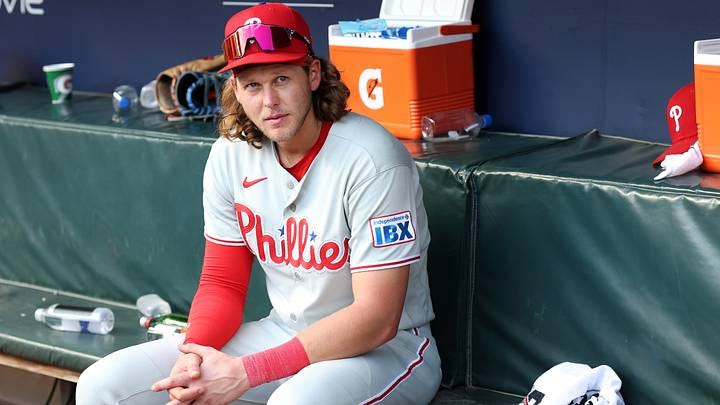
The Phillies would not offer a contract extension to Bohm. They knew who he was: a defensively challenged contact hitter. Bohm wouldn’t have agreed to a deal, either, when he was so close to free agency. So the two sides agreed to a $10.2 million contract in his last year of team control and like a warring, long-term couple in bed they grumpily turned away from each other.
Bohm would go on to have the second-worst season of his career, a disaster of a walk year. Since at least 2023, Bohm was a classic “change of scenery” candidate. He disliked playing in Philadelphia—he said as much—and seemed to have more bat slams than home runs in his career.
All the while, the Phillies since at least 2023 were desperate for lineup upgrades in a team full of expensive veterans signed to long-term deals. MLB’s existing salary cap always made Bohm either just valuable enough to keep or just not valuable enough to trade. Bohm was stuck with us and us with him.
There is a winner in this seven-year saga. In 2020 when Bohm ascended to the majors, the Phillies, owned by billionaire tobacco magnate John Middleton, were worth an estimated $2 billion. This year, when Bohm grounded into the final double play for the team, it’s up 70%, to an estimated $3.4 billion. Hang the banner.