World Cup Dispatch: I was right
All became right with the world after the games started
If you called me a FIFA alarmist, then I wouldn’t protest. Two of the best read pieces in these hallowed pages are “Everything insane at the FIFA 2026 World Cup Draw, ranked” and “New Jersey may have a ‘chilling effect’ on the World Cup. Does FIFA have a point?”
But I knew something others didn’t. I knew the 2026 FIFA World Cup would not suck.
As the opening match on June 11 approached, a myriad of articles told us What This Means. More skeptical and political takes focused on the apparent soullessness of the World Cup. Ridiculous ticket prices, xenophobic visa policies in the U.S., and even a ban on drinking water created a late-stage capitalistic zombie of a tournament. Defector’s “The World Cup For Nobody Is Almost Here” is a representative story, and even I succumbed to this thinking in a piece called “The unknowable World Cup.”
My head came in as the games grew nearer, though. On June 4, a week ahead of the proceedings, a friend expressed exasperation at FIFA’s relentless commercialization and corruption, and I responded with “I think once the games start all will be fine.” Another friend said the MAGA-FIFA alliance discouraged him from plugging into the tournament. I told him to grow up. (Sorry, Mikey, but don’t worry. I will meet you at the barricades when the revolution happens.)
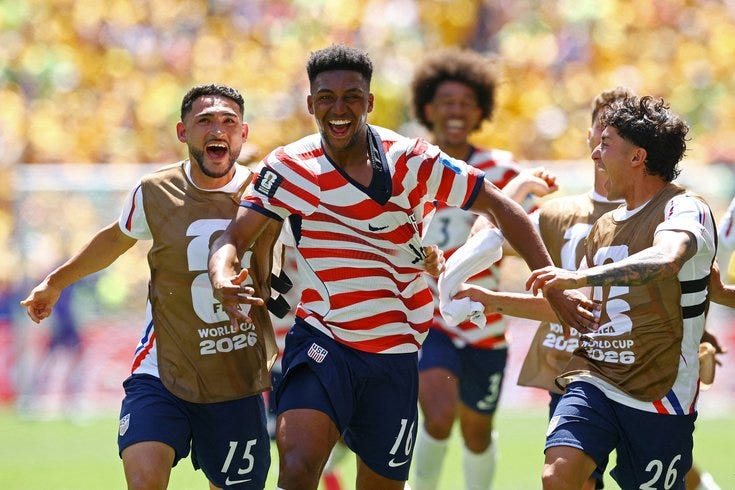
It turns out I was right. The games have mostly been competitive and entertaining. Only a couple games featured swaths of empty seats noticeable on TV, and the crowds at many games have rivaled those overseas in terms of size and passion. In a single day, France’s Killian Mbappé, Norway’s Erling Harland, and Argentina’s Lionel Messi—three of the biggest sporting stars on the planet—had multi-goal games. The teams representing the host countries are playing well, and the U.S. men’s national team won its group easily. And, through Scottish fans, Great Britain has recolonized Boston.
Commentator Alexei Lalas is probably the worst thing about the tournament, but even then the unified and universal anti-Lalas coalition has created incredible social media content. The mandatory water breaks are annoying, too. Creating more commercial breaks is one of FIFA’s most craven cash grabs, but ultimately it’s fine if the practice doesn’t metastasize throughout the sport. Watching Arsenal flop and arm-tackle opponents in the box after a three-minute water break would be pure drudgery.
Spending the summer in Philadelphia is one reason why it’s been easy for me to buy into the tournament. Along with Houston, Philly is one of only two host cities to effectuate the original vision of staging a free fan fest for all 39 days of the tournament. There is also World Cup signage and events everywhere, and the city has adequate tourist infrastructure. For two days, it seemed like every Ecuadorian on the planet was in Philly for their country’s matchup with Ivory Coast.
Calling a city a “great sports town” means nothing. It’s said about every city with at least one major league team that’s not New York or Los Angeles. But Philly truly does know ball. It has the venues to stage the biggest sports events, it knows how to stage and market them, and its people know how to engage with sports, even when they don’t care about them. They know the language and the contours of the games, if not the details. And the real fans, of course, are lunatics. It’s not luck or a coincidence that Philly’s fan fest is the World Cup’s best attended.
Another reason why I’m loving this World Cup is because I got to know a man called Bolaty Kouadio. He’s an Ivorian-American who I profiled for Football Case Study. His is a story that encapsulates so much—sports, community, immigration, service. Just as it’s cliché to call a city a great sports town, it’s cliché to say the World Cup brings people together. But I would not have met Kouadio otherwise. I would not have learned about Ivory Coast and how ridiculous it is that Ivorians are subject to the Trump administration’s travel ban.
I love bashing FIFA as much as the next Substacker. This newsletter exists because, like a good leftist, I was angry that Major League Baseball team owners locked out the players ahead of labor negotiations in 2022. It feels good, though, to let my political guard down, at least until the USMNT wins the World Cup.


We head to Seattle in two days to take in two matches! Can't wait.