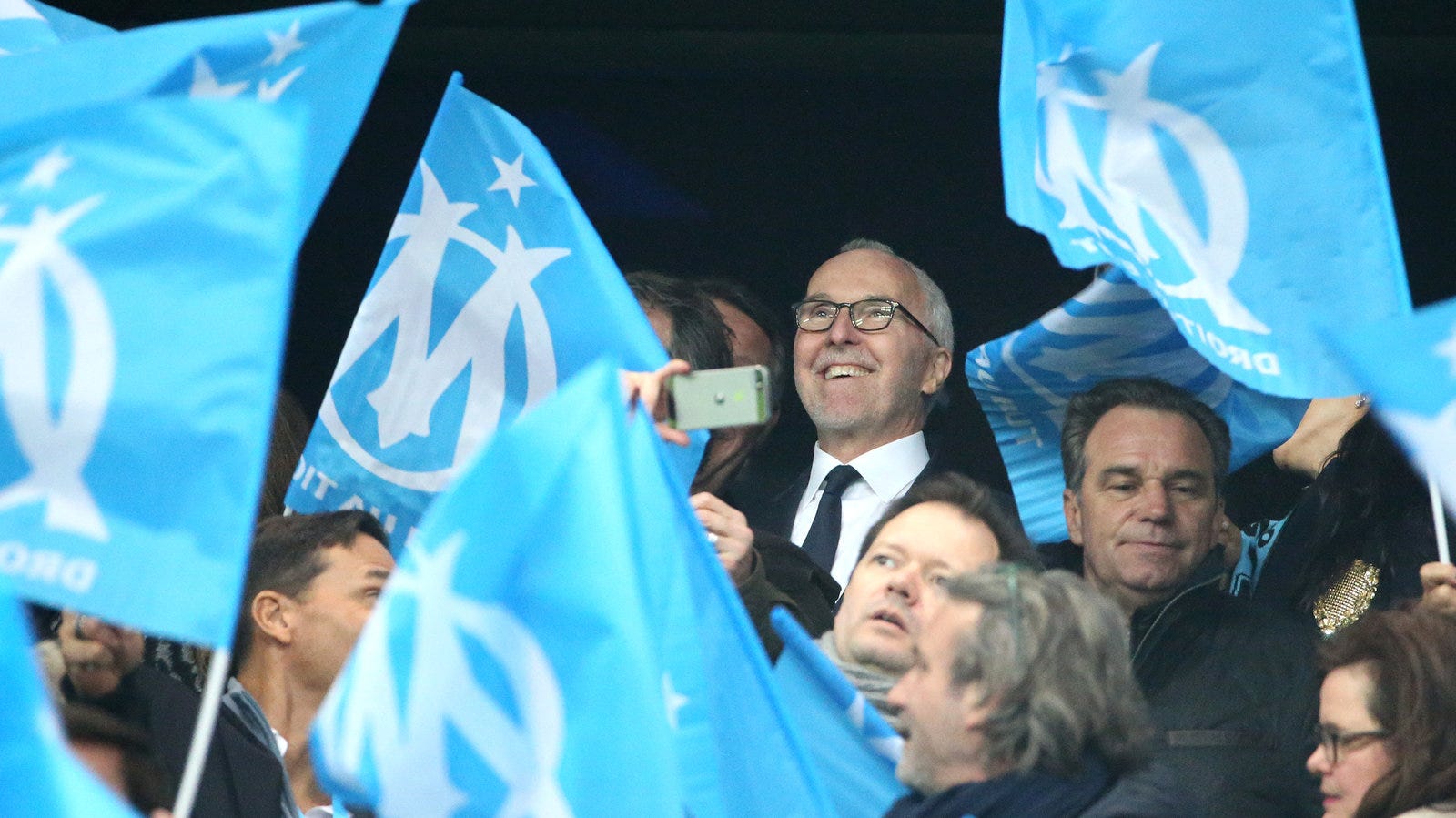
Everything Frank McCourt touches turns to crap
Why the billionaire sports executive ruins everything
The other day, a friend sent me a video about Olympique de Marseille’s recent failures as a football club. A few hours later, a different friend sent me a video about gondolas, the aerial cable transit systems. My friends hate me. They forced me to think about Frank McCourt, who sucks the soul from two sports I love.
McCourt is a 72-year-old American billionaire. He got his start in his family’s Boston-area construction business and worked his way up the real estate hierarchy until, in 2004, he achieved the rich white guy’s equivalent of a crossover hit: he bought a sports team. The Los Angeles Dodgers, to be exact.
In a sign of the times, McCourt’s $421 million purchase from News Corps was a leveraged buyout. His real estate holdings backed the debt saddled on the Dodgers, and to repay that debt he made it more expensive than ever to be a Dodgers fan. In private equity math, this made it impossible to invest in the team.
Under McCourt, the Dodgers never exceeded the 6th-highest payroll in baseball despite playing in the U.S.’s second-largest market, and in 2010 they had only the 12th-highest payroll. Consequently, they didn’t win anything besides a few National League West titles in an era in which the entire division should have been relegated to the minors. The San Diego Padres won the N.L. West in 2005 with 82 wins.
The low point of McCourt’s seven-year tenure—on the field, at least, and if you ignore the Dodgers losing back-to-back National League Championship Series to the Philadelphia Phillies—is the 2010-11 seasons, when Los Angeles finished under .500, then saw their attendance plummet amid another .500-ish season. This is when things collapsed off the field, too.
It seems quaint now, what with an American president threatening the lives of a World Cup-qualifying national soccer team, but McCourt’s divorce from his then-wife Jamie was the costliest in California history and a blockbuster sports controversy. They announced their split ahead of the 2009 NLCS, and the sports, business, and celebrity gossip industries all feasted on the details.
Frank and Jamie each claim they own the team! Frank fires Jamie as CEO! And he has HR escort her out of the building! A court invalidates the prenup! Then-California Attorney General Jerry Brown (!) reveals McCourt used a Dodgers charity to pay an associate for a no-show job! The McCourts settle, contingent on a broadcasting deal with Fox that MLB rejects! The Dodgers file for bankruptcy! Fox sues the Dodgers! MLB sues the McCourts!
Ultimately, Frank McCourt sold the Dodgers to the current ownership group for $2 billion. Not bad for a guy who, according to the Los Angeles Times, put “not a penny” of his own money into the team. There are a couple lessons. Above all, it shows that the Dodgers’ current greatness was not inevitable. Today’s concerns about competitive balance, and in turn the need for a salary cap, are manufactured by owners like McCourt who don’t want to invest in their clubs but nonetheless reap financial benefits. As McCourt did, they are content letting their franchises ripen on the vines of monopoly—team valuations are all that matter.
After the Dodgers signed Shohei Ohtani in 2024 to a $700 million deal and subsequently won the World Series, many fans felt Los Angeles was ruining baseball. That sentiment only deepened after they repeated as champions last season and maintained a $321 million payroll. To that, president of baseball operations Andrew Friedman said, “From our standpoint, that’s our only mission: to do everything we can to be great stewards of this organization and to reward our incredibly passionate fans.”
That last bit is key: The Dodgers’ present owners are piling their hoards of cash into the team because their customers can’t get enough of that elite product. If the team committed a crime, a crime grave enough to lockdown and reconstruct the sport, then it’s by embracing capitalism. Forgive me. I thought this was America.
Well, it must be, because McCourt didn’t just make hundreds of millions in profit. He also retained control of real estate around Dodger Stadium. Rich people always get theirs, and it’s why my friend texted me about gondolas.
McCourt has been trying to redevelop the parking lots at Dodger Stadium pretty much since the day he sold the team itself. The latest scheme, inching its way through the approval process, is building a cable car system from Union Station up onto Chavez Ravine. It’d be a creative and low-cost way to increase public transit to and from games, and it could open up the ballpark site to further redevelopment, including much-needed housing. McCourt even said gondola rides would be free for Dodger games.
The problem is, no one trusts the guy. Chinatown doesn’t trust McCourt will protect them from gentrification. Local residents and business don’t trust he’s being transparent with his redevelopment plans. Politicians don’t trust the studies revealing the benefits of the system. Considering Los Angeles’ untenable traffic and the popularity of the Dodgers, there are legitimate questions to address when it comes to the future of Chavez Ravine. McCourt’s enduring presence veers the political dynamic into farce.
I am resolutely pro-transit when it comes to sports, and the situation calls to mind the 76ers proposed (and scrapped) arena in Center City Philadelphia. But I cannot blame Angelenos for looking askance at the McGondolas. What has McCourt himself actually improved? His wealth stemmed from a family business he was born into, he ran the Dodgers into the ground, his proposed solution to combatting Big Tech—a bunch of billionaires controlling the internet—is for him, a billionaire, to buy TikTok, and the team he now owns, France’s Olympique de Marseille, is an embarrassing circus.
“Olympique de Marseille have adopted a unique strategy in recent years,” Alfie Potts Harmer pointed out on the HITC Sevens YouTube channel. “The Ligue 1 giants seem to focus their attention on signing the absolute dregs of society and some of the most reprehensible scumbags within the sport.” At the top of the list include:
Forward Mason Greenwood, who assaulted his girlfriend and shared videos of her injuries and was arrested for sexual assault and threat to kill. Separate incidents led him later to be charged with attempted rape.
Midfielder Amine Harit’s reckless driving resulted in his killing a pedestrian.
Forward Elle Wahi allegedly sexually assaulted and harassed fellow academy players and also punched a woman, who needed emergency care.
OM has also recently employed several controversial, if non-violent players, and since May 2019, OM has had 11 different managers, or about two per season. Manager Roberto De Zerbi, who was recently fired for a disastrous run of form and crashing out of the Champions League in spectacular fashion, said about Greenwood upon his signing with OM, “I don’t know his background. No matter the player, once they sign here they become like my children. I protect them always.” It has also come out this week that OM executives clashed over Greenwood’s signing, to the point that one filed a police report against another. McCourt, club owner since 2016, has overseen all of this. The club has won zero trophies under his stewardship.
It’s little wonder why OM supporters, at last week’s game against Toulouse, remained quiet for 45 minutes and held a banner that can be translated as, “You’re all pieces of shit.” And in 2021, a few hundred of them stormed the club’s training ground in protest. “What happened some weeks ago in Washington DC and what happened yesterday in Marseille follow a comparable logic,” McCourt said in a statement at the time, “a few sources feed an inferno of opinions, invectives, and threats that are amplified by social media creating the conditions that lead to violence and chaos.”
In fact, the insurrection was fomented by Donald Trump, who McCourt is now seemingly working with to acquire TikTok. (Not for nothing, McCourt’s ex-wife served as ambassador to France in Trump’s first administration.) Similarly, McCourt couldn’t possibly view himself as the inciting figure at OM. But maybe he isn’t the real problem. The problem is a society and culture that rewards, at the expense of sports fans, incompetent and insecure rich men.


Your friends do not hate you