Everything is private equity now :(
Thoughts on the impending sale of the San Diego Padres
I knelt before my editor at Padres Mission, and with a sword he tapped on one of my shoulders, and he tapped the other, then I rose to my feet and solemnly nodded, my mission understood: For the love of God, write something different about José E. Feliciano.
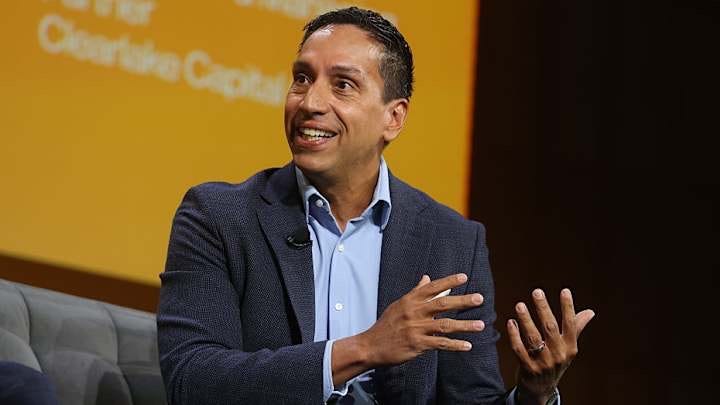
The Wall Street Journal and The Athletic had broken the news that Feliciano and his wife Kwanza Jones won the derby to buy the San Diego Padres. MLB owners approving the deal feels like a formality. Surely, they’re thinking, with cartoon money bags floating across their laser-corrected vision: If the small market Padres went for $3.9 billion, then what does that mean for me?
The blogosphere rushed to figure out and report on who Feliciano and Jones are, and a few common threads emerged. Feliciano is a Stanford MBA, the co-founder of Clearlake Capital, and the co-owner of Chelsea Football Club. Jones is an artist and a philanthropist. Together they are worth $4 billion.
I looked for another angle, and I found it in Feliciano’s “exquisitely maintained and expertly pruned” LinkedIn profile. Here is my story for Padres Mission.
I trained a critical eye on Feliciano’s wealth and private equity background, but I had to leave unaddressed many questions. Why does one person (a man, of course) feel the need to own and serve on the board of at least 33 companies? What is the social value and purpose of one man controlling that much wealth? And why does it feel like private equity has taken over the world, sports included?
Mostly because it has. Fueled by historically cheap debt, assets in private equity funds increased 15-fold from 2000 to 2022, to $8 trillion. Few industries escape PE’s reach, and several industries are dominated by it. From minor league baseball in the States to Ligue 1 in France, private equity isn’t taking over sports. It has taken over sports. The Padres’ impending sale is an example of that. At investor conferences around the world, our favorite teams are called “assets.”
This sucks because of PE’s go-to business model: use debt to acquire an asset, then slash costs—fire people—and raise revenue—increase prices and introduce new fees—to repay that debt, turn a profit, and increase the value of the company. For a baseball team with monopoly power, it’s obvious how that would go: slash player payroll, in various ways make it more expensive to be a fan, and bask in ever-increasing team values.
Team owners have been doing that for decades, though; that’s business. I’d buy this rationalization, except I think the ruthless, almost sterile ideology of private equity is particularly troublesome. For it is the Friedman doctrine raised to dementia. Historical precedent, social value, cultural importance—all is irrelevant when a spreadsheet spits out exactly what is needed for debt service and investor dividends.1
It’s true that, after buying Chelsea for over $5 billion, Feliciano and his co-investors spent billions more on player acquisitions. That’s also the case at RC Strasbourg, which Feliciano’s company also controls. Yet Strasbourg ultras protest ownership every single game, and protests are growing within Chelsea’s fandom.
It’s easy to blame rich people, who obviously benefit most from private equity. It’s easy to point at, say, Donald Trump, who everyday displays that nothing matters except power (which money is). But I think they are symptoms. At the very least, there is a symbiosis between culture and men who don’t have values. This is to say there is something depraved about us as a people to both produce and tolerate these men. Us sickos are still going to go to the ballpark, and people like Feliciano know that.
I have a theory for why PE is a major reason for the current cost-of-living crisis. PE demands returns. It needs returns, or the industry would collapse, which would mean much of the economy would collapse. This insulates PE from government interventions, from taxation to antitrust actions, which allows PE to operate as normal: increasing costs of necessities like housing, energy, and so on. This is problematic in an era of inflation, when PE can and does pass on costs to its customers and consumers. Government alternatives like, say, social housing would compete with PE-owned housing, but government needs resources to offer alternatives. And it can’t garner those resources because it’s locked in a cycle of deference and inaction.


