Philadelphia is America's best city. The 2026 World Cup proved it.
I'm exaggerating only a little
I thank my ancestors for not bequeathing me an addictive personality, but I do believe I am withdrawing from the World Cup.
For almost a month, tides of football fans from France and Ecuador and Côte d’Ivoire and everywhere else descended on and retreated from Philadelphia. Block parties shut down streets. Every establishment with a TV showed the games. Volunteers were posted in the subways and on street corners and in parking lots. The official fan fest welcomed more than half a million people.
Now, “Philadelphia Stadium” is once more Lincoln Financial Field. No one cheerily greets me on the Broad Street Line. The TVs show only the Phillies losing games in the most stupefying way possible. The fan fest is closed and Fairmount Park’s Lemon Hill returns to what no-fun NIMBYs wanted it to be all along: a lifeless grassy knoll.
The elation of hosting the World Cup and the comedown following its conclusion prove, beyond all reasonable doubt, that Philadelphia is the best American city.
It is not the public transit that makes it so, although Philly’s is probably the most underrated system in the U.S. It is extensive and diverse, offering almost every mode of transit known to man. (Just accept now that you will never know which train is which or what stop you are at without asking people around you. Suburban shopping malls have better wayfinding than SEPTA.) For World Cup visitors who experienced mostly the L-shaped corridor from the beautifully renovated and World Cup-ready 30th Street Station to the Sports Complex, it ran seamlessly.
Philly is not the best city in the U.S. because of its relative affordability. Yes, the housing marketing possesses a modicum of sanity compared to New York, et al., but that’s due in part to a shallow pool of well-paying, growing industries. If you’re not in healthcare or doing the bidding of media monopolists at Comcast, then it’s a grind here like it is in any other city.
It is certainly not the weather that makes it the best city. This July 4, Philly hosted not only a Round of 16 World Cup game between France and Paraguay, but also celebrations of the nation’s 250th birthday. It fell on a Saturday no less, and it was slated to be one of the city’s most extravagant days ever. Except the high temperature was 101 degrees Fahrenheit. The main parade was cancelled, the game was infernal, and nighttime thunderstorms meant that the fireworks commemorating Independence Day didn’t begin until 2:00 a.m. on July 5.

Philly is the best because, more than any place I’ve experienced, its people don’t compare themselves to others. They are secure in who they are.
“Philadelphians did eventually grow discouraged competing with [New York City in the 19th century],” writes historian Michael Zuckerman. “After decades, even generations, of primacy, they did ultimately reconcile themselves to second place in the American urban pecking order. And when they did – when they gave up measuring themselves against New York – they launched on their most distinctive and most marvelous innovation of all… It gave up braggadocio as a way of life.”
Nothing is inevitable in human relations. Philadelphia was (and is) simmering in a unique stew whose inputs are infinite and incalculable. I hesitate, then, to claim that any one thing is why the people here are the way they are. The social output is enduring and undeniable, though, and a contemporary example is the most recent NBA playoffs.
New York Knicks supporters followed the team and celebrated its championship as if they were owed something, as if the team was avenging some grievance, and their performative fandom reflected that. Once the Sixers were bounced from the playoffs, us fans couldn’t have cared less about the Knicks. We are the Don Draper meme: I don’t think about you at all.1 Knicks fans remained desperate for attention through the team’s playoff run.
Another example is San Diego, a city in which I lived for 12 years and helped run as a political staffer. Its insecurity is baked into its slogan: America’s Finest City. Why invest in people and the places they live when you can, say, repeat ad nauseam that Balboa Park is one of the largest urban parks in North America. Never mind that half of it is surface parking lots and its restrooms are either unsanitary or closed. When Philadelphia touts and markets something, the city doesn’t say it is better than another thing. They say it is distinctly Philadelphian. There is a fine but indicative difference in the framing.
This is not to say Philadelphians are perfect. As one coworker from the Midwest pointed out, the people here are often so self-satisfied that they deride what others have. That can be as limiting as insecurity. We confine our professional sports facilities to a distant industrial area, for instance, because of fallacious and small-minded arguments—no one takes transit here, that’ll cause gentrification there, we just don’t need that. This thinking often congeals into political inertia, and Philly does not lack for big and intractable political issues.
But only a secure people embrace a World Cup like Philadelphians did. This is to say only a secure people embrace other people unconditionally. SEPTA did not charge World Cup attendees nearly $100 to ride the train like New Jersey Transit did. Philly didn’t play a game of fiscal chicken with its host committee like Foxborough did. Philly was the only host city to actuate the original vision of throwing a free fan fest during all 39 days of the tournament.
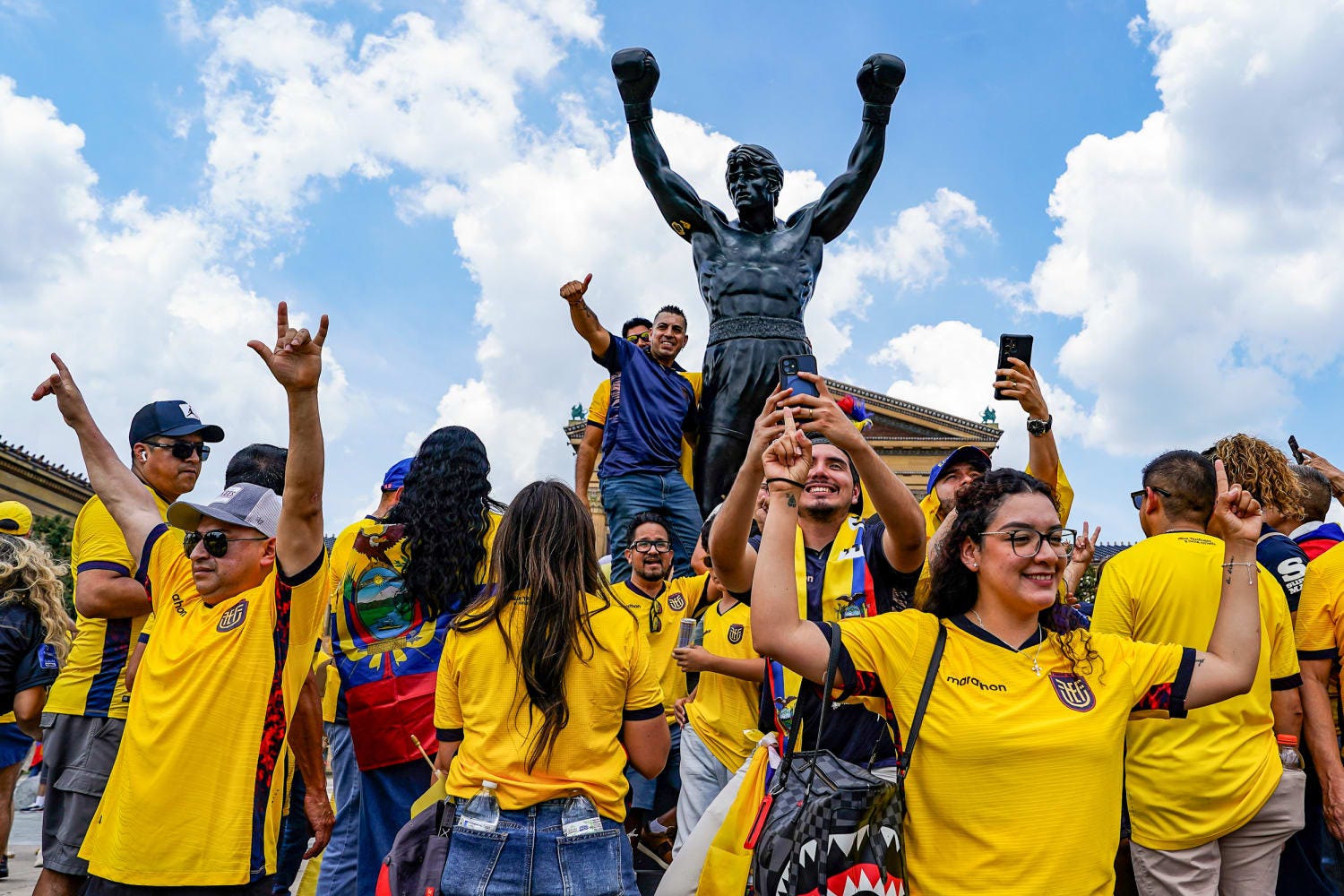
The most tangible example of Philly’s welcoming, assured spirit was when hundreds of Ecuadorian fans commandeered the famous steps to the Philadelphia Art Museum. They dressed up the Rocky statue in their country’s colors, and they chanted and sung and otherwise hammed it up for the cameras. The steps serve as the dramatic front porch of one of the world’s great art institutions, yet they were not closed off and the authorities did not chase fans from them. In bars and restaurants and stores, I didn’t hear a single resentment toward the visitors. Ecuadorians enlivened the city and brought a party, and if Philadelphians didn’t revel in the atmosphere, then they at least let it be. That relationship, even if temporary, is built on trust and acceptance, two values an insecure people lack.
Snaking in line to get into the France-Paraguay game, I spotted the guys who run the viral ATFrenchies Instagram account. The Frenchmen have garnered 2.1 million followers by playfully comparing life in France to that in the U.S., and they were everywhere for the World Cup. Philadelphia was their favorite stop, as evidenced by a quote from one of their (many) pro-Philly posts:
We fell in love because Philly doesn’t try to be perfect. It’s not polished, it’s not putting on a show for tourists, it’s just real. And somehow that’s exactly what made us love it even more. Every bar we walked into during the games, every person who smiled at us wearing our jersey, every random “allez les blues” from someone we’d never met, it added up to something we didn’t expect to feel this strongly.
FIFA made a mistake when it sited the World Cup final at MetLife Stadium in New Jersey. It’s an inaccessible non-place, but I understand why they chose it. The 2026 World Cup was the American World Cup, and to the wider world what city epitomizes America more than New York? New Yorkers are quick (and loud) to answer that question, even when the relevant stadium isn’t even in their city.
Philly was never going to host the final. Corporate suits would point to the city’s smaller stadium and its lower profile, which is business-speak for “less money can be made there.” The real reason is Philadelphians didn’t spend generations deluding themselves and convincing others that their city is something that it is not.
“When Philadelphia ceased to be the first city, it took to itself the title of city of firsts,” Zuckerman further expounds. “The title was at once a harmless expression of pride and a profound expression of identity. It signified a place that could look backward and appreciate its past as New York never did. A city civilized in an un-American way…”
As a corollary, I believe we are so quick to chastise and scorn our own teams not because we fail to prove to others that we are the best, but because it chips away at our self-assurance.


Best sports city in the world
It really is.