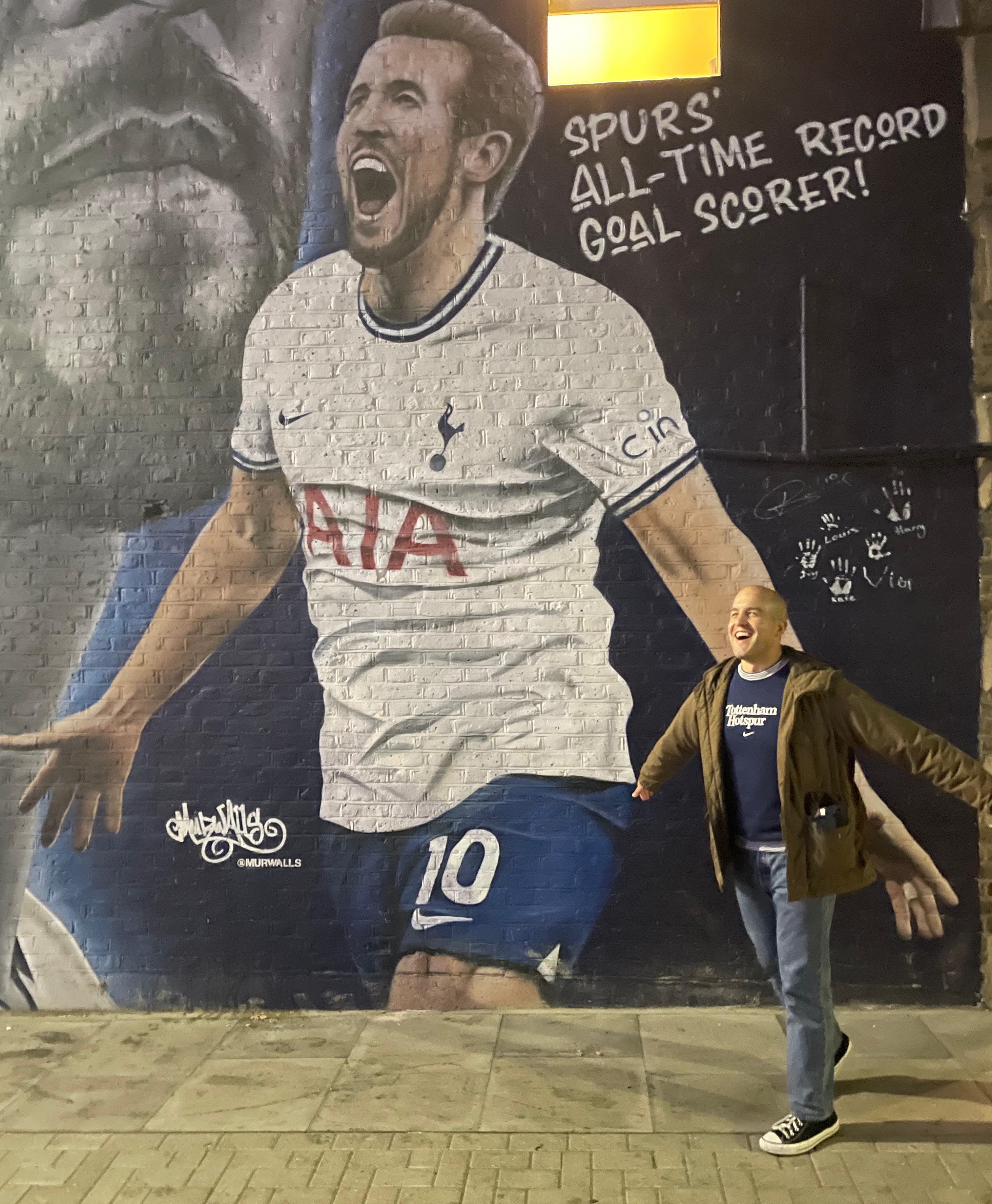
The first step of recovery is admission: I am a Tottenham Hotspur supporter
Why it's so embarrassing to cheer for one of England's "Big 6" clubs
I felt like a bozo, sitting there at the pub and looking up at the TV. Expecting Tottenham Hotspur to offer anything besides a desultory performance turned into a fool’s errand, and for that errand I wore a vintage Spurs shirt. By the 87th minute, Spurs were losing 3-0 at home. I was reminded of the opening verse of Springsteen’s “Reason to Believe”:
Seen a man standing over a dead dog
By a highway in a ditch
He's looking down, kinda puzzled
Poking that dog with a stick
Got his car door flung open
He's standing out on Highway 31
Like if he stood there long enough
That dog'd get up and run
I had traveled to London last weekend with the expectation of buying a ticket to the game. It was to be, improbably, the biggest match of Tottenham’s season. Spurs sat in 16th place, only a single point above their opponent Nottingham Forest. Both clubs were fighting for their Premier League lives, and the game represented one of those ballyhooed “six-point matches.”
In the end, my friend Ray and I decided to camp out at the pub so that, after Spurs-Forest, we could watch two grownup teams in Manchester City and Arsenal play for the League Cup final. It saved me money, but not embarrassment. Who is that American jumping out of his seat and wearing a Spurs shirt in civilized West London? [Raised hand emoji]
But it wasn’t my fault that I looked and felt like an idiot. It was the club’s owners, who thought they could run Spurs like an American sports franchise and get away with it.
I chose to support Tottenham for several, completely arbitrary reasons. First, my team needed to be in London. I appreciate Liverpool’s left-leaning ways and admire the Geordies passion for Newcastle United, but the capital is simply far more accessible. That narrowed it down to seven teams in the Premier League.
Chelsea: too posh, too recently successful.
Arsenal: certainly not recently successful, but too big. The whole world cheers for Arsenal, and I would not be joining them.
Crystal Palace: too far out, too much roof, too much piss on the ground. (Anyone who has been to Selhurst Park understands.)
Fulham: too sleepy, too genteel. Craven Cottage is a gem, but it and the surrounding neighborhood are as lively as a country club.
West Ham United: too pugnacious. Ray’s Arsenal fandom once nearly instigated a fight at West Ham’s London Stadium.
Brentford: who?
That left Tottenham as the Goldilocks team. A big, important club, but neither the biggest nor the most important. A competitive club, if not one that claimed many trophies. They sport classic colors, and they have a stadium that was both world class and relatively easy to get into. And Spurs are the butt of many jokes. Many people warned me away from Tottenham. They told me I’d be in for a lifetime of pain and futility. I told them I was already a Philadelphia Phillies fan.
Everyone turned out to be right, for the club is owned by Joe Lewis and his family. The private equity ghoul bought the club in 2001, appointed co-investor Dan Levy as chairman, and together they ushered in what must be, pound-for-pound, the most mediocre tenure in professional sports.
Until last year, Lewis’ Spurs had won just one trophy, the 2008 League Cup. The club’s winning percentage since the 2001-2 season is .462, while in the same span Arsenal, their biggest rival, has won almost 58% of their games. The successful Mauricio Pochettino era, when, from 2014-2019, the manager turned Tottenham into a regular contender and took them to the 2019 Champions League final, turned out to be an anomaly. The status quo is failure and change—Lewis and Levy have employed 20 different coaches, with at least three of them publicly expressing their exasperation with their bosses (but more on that later).
It makes sense, then, why fans regularly protested Lewis’ and Levy’s leadership, and last year Levy resigned. He had “one hand tied behind his back,” a source close to Levy told the BBC, and as a result he was forced to diversify revenue streams. It’s a telling comment, both because Levy clearly learned from his former coaches—blame ownership!—and it indicates the point of Tottenham under Lewis.
Thanks in part to their lucrative stadium, which is the best sports venue I’ve ever been to, Tottenham are, by revenue, the ninth-richest club in world football. What they do—or rather, don’t do—with that money is the problem. As the HITC Sevens YouTube channel points out, Spurs refuse to sign elite (i.e. expensive) talent, preferring instead to sprinkle their spending across a bunch of mid players.
Spurs sometimes do pursue top players, but, like with midfielder Eberechi Eze, they haggle to the point where the lose the guy. Eze went to [dry weaving] Arsenal after Spurs continued negotiating with Crystal Palace to drive his price down rather than just sign a deal. Cynically, I wouldn’t be surprised if Tottenham leadership strategically leak that they’re pursuing certain players to quell the fan base and drive up the price for competitors.
It is like what the Pittsburgh Pirates do in MLB: pinch pennies on the roster, profit from revenue sharing and a beautiful ballpark, and leak to the press largely unrealistic free agent pursuits. The Pirates have been mostly uncompetitive for decades, and their owner Bob Nutting is considered one of the worst in baseball, but why would he care when the franchise valuation is higher than ever?
Similarly, Spurs spend just 44% of their turnover on player payroll, the lowest in the Premier League, and the club’s top-line wage bill is closer to that of teams in relegation places than that of fellow “Big Six” clubs Manchester City and Liverpool.
“When you look at the expenditure, particularly in the wage structure, they're not a big club,” former Spurs manager Ange Postecoglou told The Overlap podcast in February. “I saw that, because when we were trying to sign players, we weren't in the market for those players.” Postecoglou shepherded Spurs to last year’s Europa League title, earning a place in the Champions League. It was Spurs second trophy under Lewis’ ownership, and for that success (and the honesty behind the scenes) Postecoglou was fired.
In 2023, Antonio Conte, one of Postecoglou’s predecessors, went on a legendary rant criticizing Lewis. “Tottenham's story is this,” Conte said. “Twenty years there is this owner and they never won something. Why?" Igor Tudor, the current manager, had nothing good to say about the club after a recent loss. These managers lay bare Lewis’ strategy: invest as little as possible in the product, and extract maximum profit and realize maximum value.
To Lewis, winning doesn't matter. It’s a private equity mindset toward business, but also a distinctly American viewpoint on sport. That’s further indicated by Tottenham being party to the failed Super League. Lewis wanted to insulate his club’s profits and valuation by embedding it in a closed competition, like the ones we have in the U.S. The Super League collapsed in response to widespread backlash, and unfortunately for Lewis there are still consequences in England for not investing in his team and in turn being bad at football.
Now, Spurs sit just one point above the relegation zone, and they are only that high because of some early-season success. They are not unlucky. They are truly a bad team. By almost any metric, they lack any sort of quality. By the eye test, they are worse. The Trump administration looks more organized and coherent. The Spurs project, such that one exists, is on the verge of collapse—relegation could cost them as much as £261 million.
That loss is what Lewis deserves after trying to play it both ways, but that is a write-off for someone worth $7 billion. The real pain of relegation, which, as Springsteen reminds us, is the emotional toll of believing in something, will ultimately fall on the fans. It would be disappointing to see the ninth-richest club in the world and a Premier League mainstay in the second division, but the humiliation stems from our caring, a capacity and emotion that Lewis and his ilk have snuffed out from their lives.


