


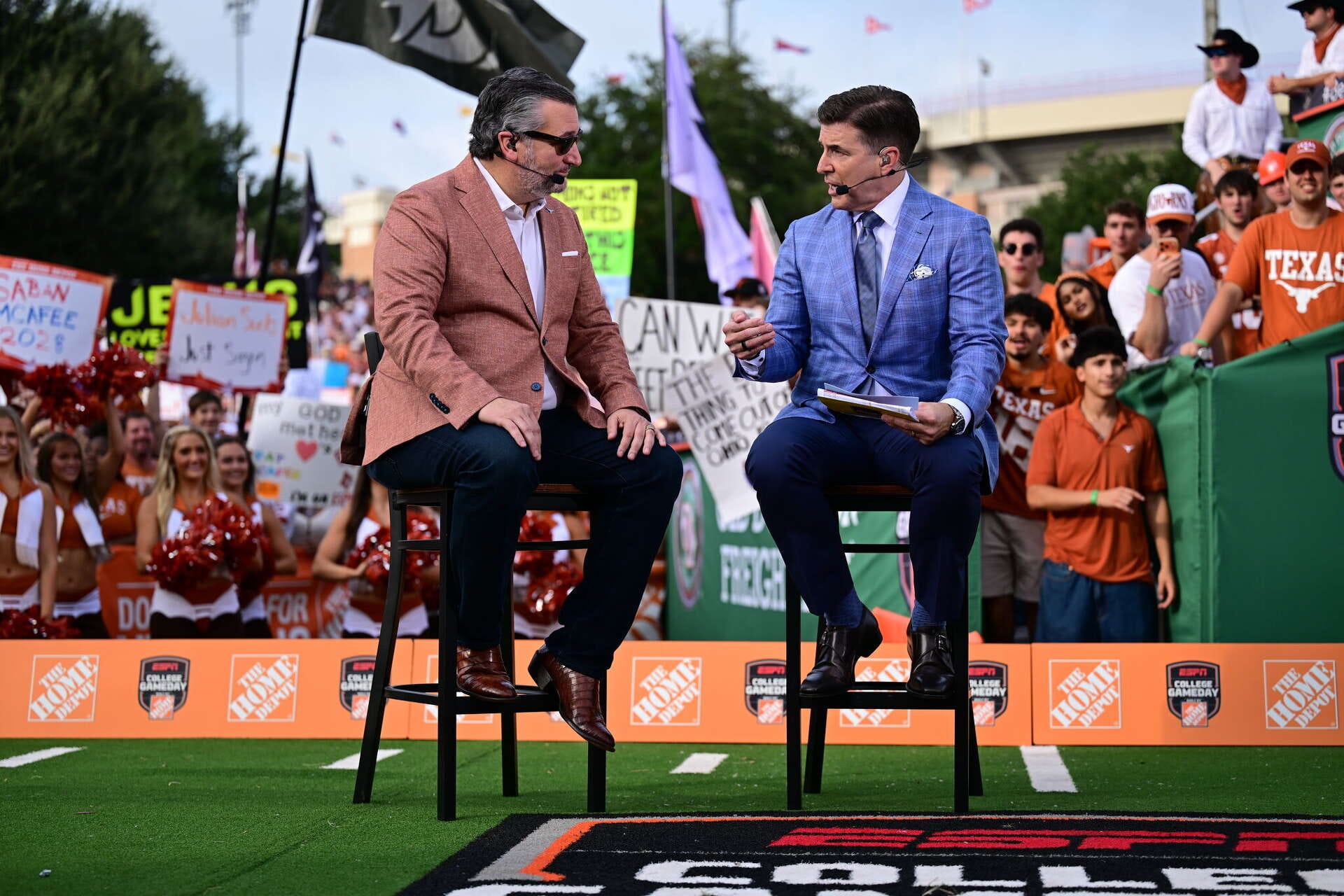
“What we have right now is chaos,” Texas senator Ted Cruz said last week. “There are no rules.”
Cruz was not talking about the artificial intelligence industry nor the wanton tariffs imposed by the Trump administration. He was talking about college sports. He was talking about his Protect College Sports Act, which passed the Senate this week. It’s a groundbreaking piece of legislation, one that regulates and reorganizes college athletics, but also one that is as misguided as it is representational.
To the former, I had little ideological faith in a bill whose lead sponsor was a senator who slipped off to a Mexican vacation during an energy catastrophe in his state. Conferences, universities, and many college football coaches, including Colorado’s Deion Sanders, also advocated for the bill. If the law is misguided it is because it serves the most powerful. T’was ever thus. I am more interested in the latter.
When in some far-off century alien archaeologists descend to Earth they can wipe the debris from the Congressional Record and reconstruct the 2026 version of the United States from the Protect College Sports Act. All of our society and culture is in it. At the top of the list is the Act’s labor provisions.
On this point, the bill does a lot, including:
Imposes a hard “salary” cap
Limits players to one “free” transfer (with exceptions)
Limits compensation of player agents
Limits player eligibility to no more than five years
A series of court rulings in recent years ushered in an era of player free agency. Student-athletes could transfer as much as they wanted, they could earn money through endorsements, the schools were ordered to directly compensate their players, and some players even went pro, realized they were swimming in deep waters, and returned to the familiar (and lucrative) shores of campus.
After decades of uncompensated labor in the name of amateurism, players were finally earning a buck, and it cleared the smoke around an uncomfortable, existential question: What is the point of amateur college athletics? This is the so-called chaos that institutions, conferences, and coaches wanted to tame. College athletics were literally all fun and games until schools, suddenly needing to buy talent on the market, were thrown into a recruiting arms race of their own making.
Knowing they could not invalidate court orders, and obviously unwilling to risk a revolt among players, the powers-that-be turned to Congress to impose regulations. Under the Act, players can continue to get paid, though with stringent limits. (Indicatively, there are no compensation limits for coaches or school administrators.)
It’s not just what is in the bill, either. The Act is silent on the employment status of student-athletes, which is a crucial legal distinction. As employees, players would be expressly able to organize and file for union recognition and collectively bargain. There have been many such unionization efforts through the years in the college ranks, but legal technicalities and institutional resistance, including from the players’ universities and the National Labor Relations Board, have strangled any widespread movements.
That ambiguity pervades the Act. Everyone refers to it as college sports’ new “salary cap,” but the text makes clear—in the way that legal text does—that payments from universities are not compensation and therefore not salaries. Payments to athletes are a benefit from revenue share stemming from a previously agreed settlement for the purpose of retaining student-athletes.
This view of labor, that it’s a costly nuisance to be subjugated, is endemic right now. MLB team owners are about to shut baseball down, which is more popular and lucrative than ever, because they want a salary cap. The NBA’s infamous second apron, implemented a couple of years ago, functions as a salary cap and is distorting team building. Outside of sports, the federal minimum wage hasn’t been touched since 2009, despite an inflationary economy and union approval ratings being the highest in decades.
It’s not a coincidence that a resurgent post-Covid class consciousness is met with a fanatical anti-labor politics. High costs are impacting everyone, and to protect profits businesses are desperate to deflate the one cost driver they have direct control over. Just don’t call an institution of higher learning a business. I am sure that any excess funds generated by, say, the Trojan football team are invested in the University of Southern California’s educational programming.

I’ll highlight one more irony. In the same week that his bill passed, Cruz took a hatchet to proposed AI regulation, blocking their consideration in the Senate. About one proposal, he said, “That concerns me, because it is difficult to imagine what an ambitious bureaucrat couldn’t shoehorn under this broad authority.” The Protect College Sports Act grants broad authority to the NCAA to enforce the provisions of the Act and establishes a Commission on the Future of College Sports. It also prohibits the mergers of conferences into “super leagues” and permits the pooling of media rights. These latter provisions require exemptions to antitrust law, which famously never result in increased costs for consumers (see: MLB).
To their voting bases, legislators paint themselves as faithful partisans and trustworthy ideologues, but in legislative politics party and values don’t mean shit, or at least their downhill of power. The Protect College Sports Act is about protecting the powerbrokers of college sports. That is neither the players, whose labor makes the games possible, nor the fans, who in one way or the other pay for that entertainment. Cruz’s comments in other contexts about small government and free markets were not going to stop his efforts serving the interests of those powerbrokers.
(Okay, one more (tangential) irony. MLB’s antitrust exemption was granted by the Supreme Court in 1922. In subsequent challenges to that ruling, the Court said that, while the original ruling is probably faulty, it is Congress’s job to determine antitrust policy and therefore it is only Congress who can repeal MLB’s antitrust exemption. Congress has not done so, given MLB team owners’ collective power, but here we have the Senate granting new antitrust exemptions to the NCAA and its television partners. The Court today will not bat an eye. I hope our alien archaeologists can parse out our brand of rule of law.)
Finally, the passage of the Act reflects political realities of our time. It was one of the Senate’s last orders of business before the November midterm elections in era in which inflation is eating away at the economy, the country is bungling another war in the Middle East, Trumpian economic policy is isolating the US, and climate change—just kidding. Nobody cares about the environment.
In any event, college sports governance not only being at the top of the docket, but also receiving a comfortable 77 votes reflects what our government deems important. And what is important in America in 2026 is capping workers’ pay and entrenching the power of institutions, both public and private, whose sole purpose, whether explicit or not, is to make money. Fight On, amirite?
Well I'm glad "Lyin' Ted" is up on the important issues. What a clown.
Was listening to a podcast and they mentioned that recent evidence shows that our government is more responsive to business interest than to actual everyday people and now I see that everywhere