World Cup Dispatch: Gianni Infantino was right
I've got to give credit where it's due
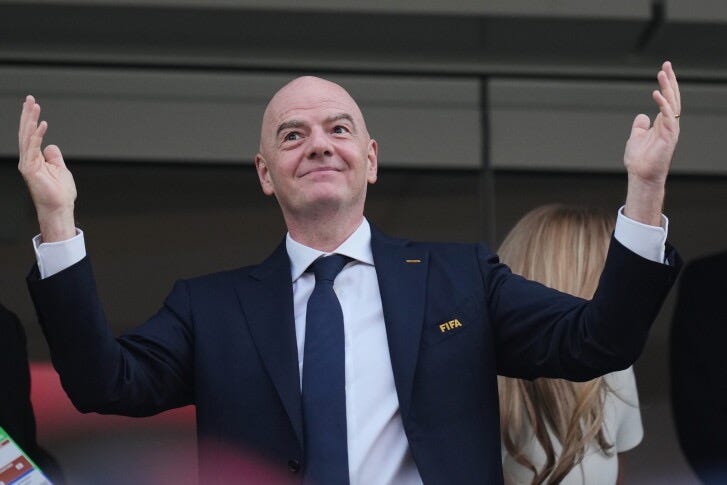
In my last post, I reveled in being right about the World Cup. Now, I must admit that FIFA president Gianni Infantino was right. The 2026 FIFA World Cup is “the greatest event that humanity, that mankind, has ever seen and will ever see.”
Infantino said those words in December, at FIFA’s shambolic World Cup draw. It was, in every regard, an insane television production, and in this publication’s best-read piece I derided Infantino’s Trumpian proclamations. I must repent.
With six years of buildup, almost every aspect of this edition of the World Cup was sliced and diced. Principally, of course, is the competition on the pitch. It expanded from 32 to 48 teams, a move widely considered a cash grab by FIFA. More teams meant more games for which to sell broadcast rights and tickets. It would also dilute the quality of teams and in turn the quality of play.
I was agnostic on this point. Expanding a quadrennial international tournament is not the same as, say, expanding the Major League Baseball playoffs, which devalues regular season performance and actually dilutes the competition (see: the 2020 and 2023 Miami Marlins). Not only has the World Cup not lost any luster with an expanded field, but we have gained so much as fans.
Would we have experienced the endearing Tartan Army? The last time Scotland qualified for a World Cup was 1998. Would we have seen vikings on North American shores a thousand years after Lief Erickson? Norway also last appeared in that 1998 World Cup. Would Cabo Verde have stolen our hearts? At just over 500,000 people, it is the smallest nation to appear in a knockout game, and they pushed world champions Argentina to the brink.
It’s impossible to say whether these teams would have missed the World Cup or not with a smaller field. Different stakes may have changed how qualifying competitions were played. We did get a few clunkers—sorry, Uzbekistan and Tunisia—but the 32-team format was not immaculately conceived and handed down from the heavens. It was adopted less than thirty years ago, again in 1998.
Another competitive change was instituting mandatory hydration breaks. The three-minute, mid-half breaks essentially turned soccer into a four-quarter game, creating a commercial break that otherwise wouldn’t exist.
FIFA insists that this was purely a sporting decision, that player welfare amid the summer heat is paramount. Infantino even claimed that FIFA makes no additional money from the breaks, what with broadcasting deals signed years prior. I’m not so World Cup-pilled to believe that, not when FIFA temporarily banned water bottles, but at some games hydration breaks have been absolutely warranted for players and fans alike.
The hydration breaks have mostly been fine. The game is not gone, as conservative purists like to claim. Still, it’s a break in the action. Just don’t make these the norm across the sport, unless the temperature exceeds some threshold and unless organizers remain committed to playing “Living On a Prayer” during breaks.
The real treat of the World Cup is off-the-field, and it was put best by an Instagram reel I came across. The World Cup is making hanging out cool again. We don’t need to coordinate a date, we don’t need to contrive small talk. Just look at the game schedule and let’s meet wherever they are showing the games (which is everywhere). Just look at what country colors someone’s wearing and strike up a convo.
A German fan got emotional talking about the hospitality that Bostonians showed towards him. American-Scottish relations are, by flight demand, at an all-time high. An elderly man cheerily welcomed the Algerian national team to Lawrence, Kansas. For my part, I’ve gone to Philadelphia’s free fan fest several times, and each time I am astounded by the high-quality production, the hospitality of the staff and volunteers, and the many thousands of fans from all over the world wanting to watch soccer together on a random weekday afternoon.
Last week, Slate published an article called “How Diaspora Communities Made the World Cup Great Again.” On the same day, The Athletic published a piece titled “In the United Stats, Every World Cup Team is a Home Team.” This is a significant shift from the mostly negative coverage ahead of the tournament. The World Cup was just an empty corporate vessel. It was Nobody’s World Cup. Now, the country is enlivened, perhaps surprisingly so, by overlooked people who claimed it their own. The World Cup in Philly has created (and tapped into) this comforting, communal, and informal social current. It feels like a festival everywhere. I’m sad that this wave will eventually crest. In Philly, it kind of already has.
The Paraguay-France game this past Saturday was the last of the five games the city hosted. I bought tickets with a friend, and before the game we convened at a bar, where we met a father and son in town for the game. We talked soccer, then they asked if we could help shepherd them to the stadium. They had never been there and were unfamiliar with SEPTA.
At the stadium, Paraguay and France fans traded chants, though in good fun, and neutrals smiled sweatily. The atmosphere was one of elation, not aggression. Not even Paraguay’s brutal and at times underhanded tactics infected the mood. After the game, volunteers directed fans to either a pop-up FIFA village or to the train stop. SEPTA had several trains waiting at the platform. Within 30 minutes, we were back at the bar talking to strangers who asked how the game went.
It capped a three-week period in which Côte d’Ivoire became Philly’s home team, Ecuadorian fans learned never to dress-up the Rocky statue, and fans from Croatia and France and Haiti and Curaçao marched down Broad Street.
The ticket situation was and will always be bullshit. Whenever anyone asks how much I paid for Paraguay-France, I quote a subpoenaed Mark McGwire. I’m not here to talk about the past. The visa restrictions and travel bans that prevented some fan bases from coming to the States also were a national embarrassment. I pin these less on FIFA and more on the U.S. government.
We lack the consumer protections and market regulations that peer countries do, and we as a people have twice now chosen the policies of the Trump administration over alternatives. FIFA was playing a game for which we made the rules. If we weren't excited for the World Cup on political grounds, then we must first look at ourselves.
This does not absolve FIFA of blame for the tournament’s geopolitical failings or its tactical shortcomings. Staging several games, including the final, at MetLife Stadium has turned out to be a bad choice. Its flip-flop on the water bottle policy further shows how brazenly FIFA has commercialized the games and confused attendees, right up until kickoff.
Nor do I give FIFA credit for how great the games have been. FIFA is a blatantly corrupt organization, one that attracts prosecutors as cyclically as it stages a World Cup. (Netflix’s FIFA Uncovered is essential viewing.) Infantino stands for nothing except for power. If he was right about this World Cup, and he is, then it’s because of everyday people who, given every reason to do the opposite, were not ashamed to care.


I believe your exact word when I asked how much you paid was “nosey”